In the construction industry, safety is not optional. It is a legal obligation and a…
Monday Tech Talk – Roof Safety
Roof safety is not an afterthought. It begins at the drawing stage, is reinforced through construction, and must be preserved for the entire lifespan of the building. Whether inspecting a new development or revisiting an aging facility, the objective remains the same: eliminate fall risks wherever possible, control the ones that remain, and ensure every worker who accesses the roof can do so safely and confidently.
This article explores how safe roof design is planned, built, and maintained, connecting legal requirements to practical solutions, engineering principles, and real-world scenarios commonly found in the built environment.
Fall Risk: Eliminate First, Control Second
The most reliable fall protection is the kind designed into the building from the start.
Whenever a roof edge is one metre or more above the adjacent level, the baseline expectation is permanent edge protection — typically a parapet or balustrade at least one metre high.
Exceptions exist only when access is genuinely restricted through robust, consistently maintained barriers. In all other circumstances, if people can access the edge, the edge must be protected.
Early design decisions unlock safe service routes, enclosed fragile elements like skylights, and clearly defined maintenance zones. Where permanent barriers are not feasible, engineered fall arrest systems — lifelines, anchor points, and certified arrest devices — must take their place and be properly designed, inspected, and labelled.
Edge Protection: What Compliance Looks Like
A compliant parapet or guardrail is a safety system, not a decorative feature.
Key characteristics include:
- Minimum 1 000 mm height
- Continuous protection around corners and transitions
- No gaps where a person could slip through or around
- Controlled penetrations for services
- Trip-free detailing around coping and drainage
Where permanent protection is not installed, fall arrest becomes the primary system. Anchor points must be marked clearly with usage limits, required PPE (e.g., energy absorbers), and ground-clearance information. Labels must be legible at point of use to support safe decision-making.
Safe Access: Getting Workers To and From the Work Area
Safe roof access is deliberate and designed — never improvised.
Access points such as fixed ladders, staircases, and walkways should:
- Be identifiable and controlled
- Route workers safely to plant, skylights, and maintenance areas
- Avoid fragile zones or exposed edges
- Prevent unauthorised entry through gates, locks, or key management systems
Improvised access routes — climbing through balustrades, stepping over ducting, squeezing through openings — are indicators that the current system is unsafe and requires redesign.
Maintenance Planning: Designing for the Next 25 Years
A roof must support safe maintenance for its entire service life.
This means designing and documenting:
- Anchor points and lifelines near plant and inspection areas
- Clearly demarcated fragile zones
- Safe approaches for rope access if the building requires façade maintenance
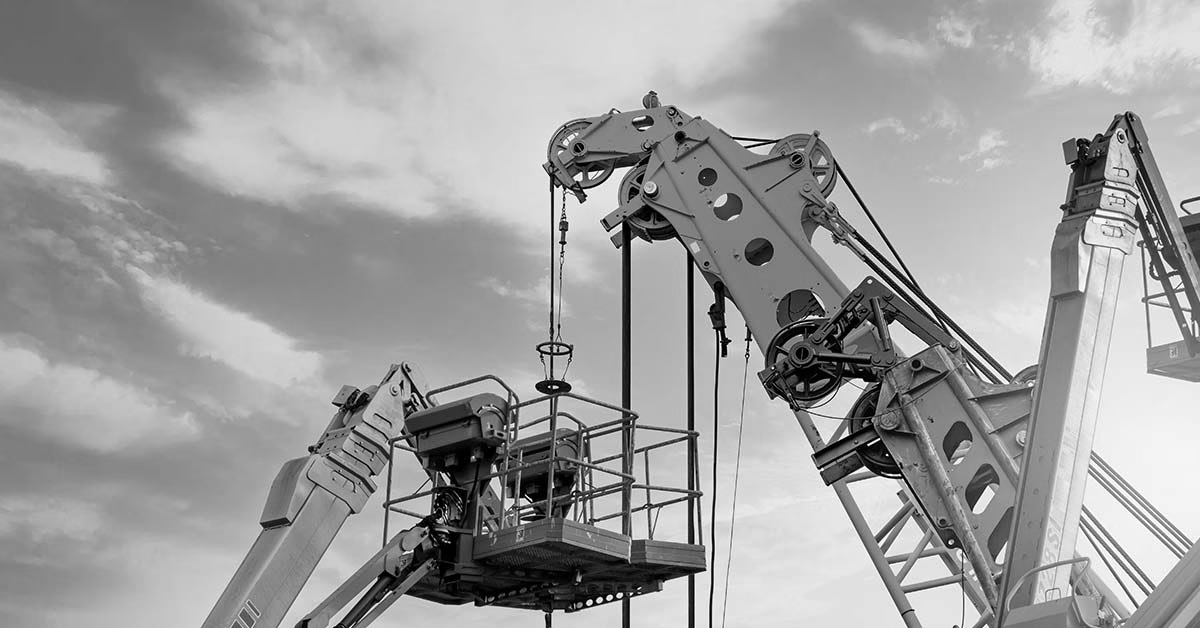
- Hard standings or structural provisions for suspended platforms or MEWPs
- Annual inspections of anchor points by competent persons
- Retention of drawings showing exact lifeline and anchor layouts
Safe maintenance is not a reactive activity — it is planned into the building.
Load-Bearing Capacity: More Than Just a Roof
Roofs must support more than their permanent structural load. Workers, tools, and temporary maintenance equipment add additional weight.
If there is any uncertainty about a roof’s capacity, structural confirmation is required. Walkways, structural strengthening, or relocation of plant may be necessary. This must be documented as part of the maintenance strategy — not assumed.
Legal Requirements Shaping Roof Safety
Two core standards guide much of roof safety in South Africa:
SANS 10400 Part D – Public Safety
Requires parapets or balustrades where drops exceed one metre unless access is genuinely excluded.
SANS 50795 / EN 795 – Anchor Devices
Sets requirements for markings, load capacity, user limits, and annual inspections of anchor devices. Tags and certificates must match — if they don’t, the anchor cannot be used.
Additionally, the Occupational Health and Safety Act (General Safety Regulations 13A(6)) specifies requirements for fixed ladders and cat ladders, discussed next.
Cat Ladders and Fixed Ladders: Frequent Failure Points, Straightforward Fixes
Fixed ladders, while simple in appearance, are common sources of non-compliance. Key requirements include:
- If the ladder exceeds 5 m, additional safety features apply
- Safety cage must begin within 2.5 m of the lower level
- Cage must extend at least 900 mm above the top landing
- Rungs must be spaced at least 150 mm from the wall
- If no cage exists, rest platforms must be provided every 8 m
Frequent problems include short cages, missing or broken trap doors, uncontrolled access, and unsafe rung spacing. Fortunately, corrective measures — extending cages, repairing trap doors, adjusting rung clearance — are straightforward and should be prioritised immediately.
Fixed ladder requirements apply equally to tanks, silos, and industrial structures.
Real-World Scenarios: What Unsafe Conditions Look Like
Unsafe conditions often arise from incomplete planning or oversight, for example:
Scenario 1: HVAC units near exposed edges
Maintenance requires leaning out or removing panels, placing workers at risk. Solutions include adding parapets, guardrails, or certified anchor systems with clear access routes.
Scenario 2: Unsafe plant room access
Workers climbing through awkward openings or over unprotected edges signals design failure. Redesign access routes, add platforms, or install guardrails and access control.
Scenario 3: Façade maintenance gaps
If rope access or suspended platforms are required, the roof must support them with engineered anchor points and compliant access. Improvised systems are not acceptable.
Drawings and Documentation: Your Long-Term Safety Record
Drawings must clearly indicate:
- Parapet heights
- Guardrail locations
- Areas requiring repair or corrosion treatment
- Cat ladder compliance requirements
- Lifeline and anchor layouts
Documentation must be preserved and matched to anchor tags, including serial numbers, inspection dates, and certification details. If a certificate cannot be matched to an anchor, the system cannot be trusted or used safely.
Roof safety is not a single decision — it is the sum of hundreds of design, construction, and maintenance choices. Each parapet, anchor point, ladder, walkway, and inspection record plays a role in preventing falls and ensuring predictable, long-term safety.
The question is simple: will the design protect workers today, tomorrow, and for the next 25 years?
Related Posts