Understanding the Risks and Legal Responsibilities Construction sites are complex environments where a variety of…
When Paperwork Fails, People Get Hurt
Administrative Breakdowns Behind Major South African Construction Incidents
Construction failures are often analysed through an engineering lens. Structural integrity, load calculations, material performance and workmanship typically dominate post incident discussions. While these factors are undeniably critical, a review of several significant South African construction incidents demonstrates that technical failure is frequently preceded by governance failure.
In many cases, investigations have revealed that administrative controls were either absent, bypassed or inadequately enforced long before physical collapse occurred. Approvals were incomplete, stop notices were not adhered to, professional oversight was insufficient or accountability structures were unclear. These are not clerical oversights. They are systemic weaknesses that erode the safeguards embedded in the Occupational Health and Safety Act and Construction Regulations.
The incidents below illustrate how administrative breakdowns form part of the causal chain in major construction failures.
Tongaat Mall Collapse, KwaZulu-Natal (2013)
The collapse of the Tongaat Mall during construction resulted in two fatalities and multiple injuries. Subsequent investigations by authorities identified serious compliance failures. Reports indicated that construction progressed without properly approved building plans and that regulatory stop notices had not been effectively adhered to. Questions were also raised regarding the adequacy of professional oversight and statutory approvals.
While the structural failure was visible and immediate, the enabling conditions were administrative. When projects proceed without validated approvals or in defiance of enforcement directives, the regulatory safety net is compromised. The absence of lawful authorisation and documented professional accountability removes a fundamental layer of risk control before any physical load is applied to the structure.
Dr Pixley Ka Isaka Seme Memorial Hospital Roof Collapse, KwaZulu-Natal (2017)
The partial roof collapse at the Dr Pixley Ka Isaka Seme Memorial Hospital during construction led to multiple injuries. Reports surrounding the incident highlighted concerns relating to contractor compliance, supervision and quality control processes. Oversight and enforcement of approved construction methodologies were scrutinised, with indications that governance systems may not have functioned effectively.
Construction methodology is not merely a technical exercise. It is formalised through method statements, design approvals and documented supervision processes that ensure execution aligns with engineering intent. When these administrative systems weaken, deviations can occur without detection. The physical failure may manifest suddenly, but the erosion of oversight often develops over time through inadequate monitoring and enforcement.
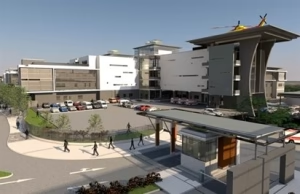
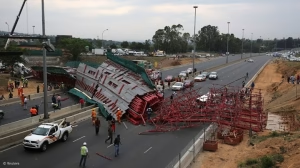
Grayston Drive Pedestrian and Cyclist Bridge Collapse, Sandton (2015)
The collapse of the pedestrian bridge on Grayston Drive resulted in fatalities and serious injuries. Investigations and professional inquiries examined the adequacy of temporary works design, risk assessments, communication between parties and professional sign-off processes.
Temporary works present an elevated risk because they are transitional and often constructed under time pressure. For this reason, they require rigorous documented design, independent checking and formal approval. Administrative clarity regarding roles, responsibilities and engineering certification is essential. Where approval chains are unclear or inadequately enforced, risk can migrate directly from design assumptions into physical instability. The absence of robust governance around temporary works significantly increases exposure to catastrophic failure.
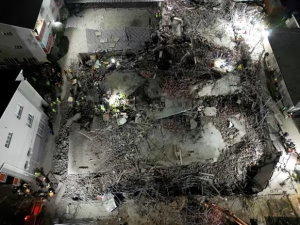
Dura Roof Factory Collapse, Pinetown (2022)
The collapse of the Dura Roof factory building in Pinetown resulted in multiple fatalities and injuries. Investigations examined structural integrity, compliance verification processes and oversight mechanisms. As with previous incidents, attention extended beyond materials and workmanship to the adequacy of inspections, certifications and regulatory enforcement.
Inspection regimes, sign-off processes, and compliance verification mechanisms are administrative control measures. They are designed to identify deviations before they escalate into structural instability. When inspection systems are absent, inconsistent or poorly enforced, unsafe conditions may persist unnoticed. The failure of administrative safeguards allows latent defects to remain embedded within the structure until collapse occurs.
Recurring Governance Themes in Major Incidents
Although each incident differs in context and technical detail, several recurring governance themes emerge:
- Construction progressing without fully approved plans or authorisations
- Stop notices or enforcement directives not adequately respected
- Weak professional oversight or unclear accountability structures
- Inadequate enforcement of documented methodologies
- Insufficient compliance verification and inspection processes
These themes illustrate that governance failures often form part of the causal pathway to physical collapse. The hazard is not merely structural; it is organisational.
Administrative controls under the Occupational Health and Safety Act and Construction Regulations are not peripheral requirements. They allocate responsibility, confirm competence, verify engineering intent and create traceable records of risk management implementation. When these systems operate effectively, they provide a structured barrier against unsafe execution.
When they are treated as formalities or delayed under programme pressure, the barrier weakens.
Governance as an Operational Safety Control
It is important to distinguish between documentation for appearance and documentation that serves as a control measure. A safety file stored on a shelf does not reduce risk. However, a safety file that is actively implemented, reviewed and enforced forms part of a live management system.
Effective governance requires:
- Formal appointments that are understood and exercised in practice
- Site-specific risk assessments aligned to actual conditions
- Approved method statements that are monitored during execution
- Verified professional sign-off for structural and temporary works
- Inspection registers that reflect genuine, timeous verification
When governance systems are operational, they define authority and accountability. They clarify who is responsible for critical decisions and ensure that deviations are identified early. They create transparency and enable enforcement.
Major construction collapses rarely begin at the moment concrete fails. They are often preceded by a gradual weakening of administrative controls. Decisions to proceed without approvals, to dilute oversight or to ignore enforcement directives introduce systemic vulnerability long before visible instability appears.
In this context, governance should not be viewed as bureaucracy. It is a legally mandated safety mechanism embedded within the regulatory framework. It provides structure to risk management and ensures that engineering intent is translated into controlled execution.
When administrative systems are robust, they reduce the likelihood that technical failure will occur. When they are weak, the consequences are rarely immediate, but they can be severe.
Effective construction safety therefore begins not only with competent workmanship and sound engineering design, but with operational governance that is consistently applied, enforced and respected.
Image Credits
Tongaat Mall Collapse imagery: Licensed editorial images sourced via Getty Images and/or Reuters archives.
Dr Pixley Ka Isaka Seme Memorial Hospital construction imagery: Licensed editorial images sourced via recognised South African news publications including News24, IOL and TimesLIVE.
Grayston Drive pedestrian bridge collapse imagery: Licensed editorial images sourced via Getty Images, Reuters and South African news publications.
Dura Roof factory collapse imagery: Licensed editorial images sourced via recognised South African news publications including eNCA, News24 and TimesLIVE.
Related Posts